
Ceramic foam filters for aluminium casting are open-cell alumina (Al₂O₃) refractory structures rated for continuous service up to 1200°C, available in pore densities from 10 PPI to 60 PPI and standard sizes from 40×40mm to 584×584mm, capable of removing 70–97% of non-metallic inclusions from molten aluminium alloys — with AdTech’s ISO 9001:2015 certified Al₂O₃ filters delivering consistent filtration performance across automotive wheel casting, aerospace structural components, cylinder head production, and all other aluminium foundry applications where inclusion-driven rejection, porosity defects, and mechanical property inconsistency represent the primary quality and cost challenges.
At AdTech, we manufacture and supply alumina ceramic foam filters to aluminium foundries on every continent. The conversations we have with casting engineers and procurement managers consistently circle back to the same core challenges: rejection rates from oxide bifilm inclusions, elongation and fatigue life shortfalls in safety-critical castings, premature tool wear during machining of inclusion-contaminated material, and the difficulty of reliably selecting the correct PPI rating for a specific combination of alloy, melt cleanliness, and casting geometry.
Why Aluminium Casting Requires Ceramic Foam Filtration: The Inclusion Problem
Molten aluminium is extraordinarily reactive with atmospheric oxygen. Within seconds of any surface disturbance — during melting, alloying, degassing, transfer, or mould filling — aluminium oxide (Al₂O₃) films form on the metal surface. These oxide films, called bifilms, fold onto themselves when turbulence causes the metal surface to fold inward, creating double-layer oxide defects with an unbonded interface that acts as a pre-existing crack within the solidified casting.
The consequences of bifilm inclusions in aluminium castings are well-documented and severe:
Reduced elongation: Bifilm inclusions act as stress concentrators that initiate ductile fracture at strains far below the theoretical capacity of the alloy matrix. A356 aluminium with a bifilm population can show elongation of 3–5% where the same alloy, properly filtered and degassed, achieves 8–12% elongation.
Fatigue life reduction: Fatigue cracks initiate preferentially at bifilm edges and surface oxide inclusions. Automotive wheel castings with unfiltered metal show fatigue life reductions of 30–60% compared to filtered equivalents — a safety-critical difference in rotating structural components.
Machined surface porosity: When a bifilm inclusion lies near a machined surface, the machining operation opens the bifilm, creating a pit or void that appears as porosity on the finished surface. This causes pressure-tightness failures in hydraulic components, rejection of cosmetically critical parts, and warranty claims on consumer-facing surfaces.
Hard particle inclusions causing tool wear: Refractory fragments from ladle linings, furnace walls, and degassing rotors travel with the metal stream and become embedded in castings. These hard ceramic particles destroy carbide cutting tool edges during machining operations at costs that can reach USD 5–25 per affected casting in tooling replacement and machining time.
Ceramic foam filtration directly addresses all of these mechanisms. A properly specified and installed alumina ceramic foam filter removes 70–97% of inclusions by count from the aluminium stream passing through it, depending on PPI rating and melt cleanliness — transforming metal quality in a single, low-cost process step.
The Economic Case for Ceramic Foam Filtration
We consistently calculate positive ROI for ceramic foam filter investment in aluminium foundries based on documented rejection rate reductions. Consider a typical scenario:
- Filter cost per casting: USD 0.50–2.50 (depending on filter size and grade)
- Rejection rate before filtration: 6–12% (inclusion-related causes)
- Rejection rate after filtration: 1–3% (inclusion-related causes)
- Casting value at risk per rejection: USD 8–150 (depending on component)
- Net saving per 1,000 castings: Reduction of 50–90 rejection-related losses versus filter cost
The payback calculation is straightforward, and we have never encountered an aluminium foundry where properly specified ceramic foam filtration failed to show positive ROI within weeks of implementation.
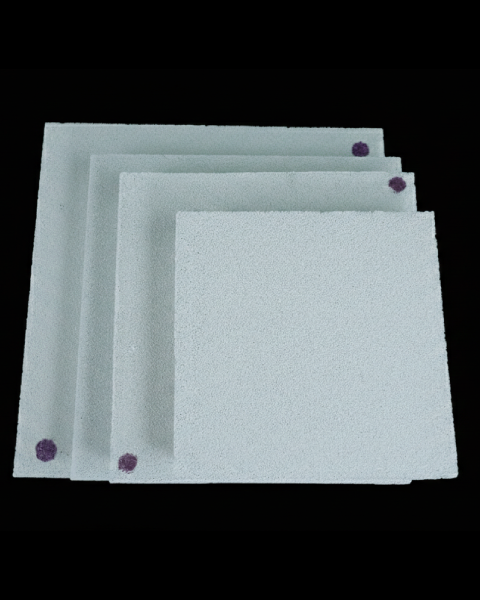
Ceramic Foam Filter for aluminum
Why Al2O3 Is the Only Correct Ceramic Material for Aluminium Filtration
This question comes up repeatedly, and the answer is rooted in fundamental thermochemistry. Molten aluminium is one of the most chemically aggressive liquids encountered in industrial processing. It readily reduces metal oxides whose standard free energy of formation is less negative than that of Al₂O₃.
Aluminium oxide (Al₂O₃) has a standard free energy of formation of approximately -1,582 kJ/mol — among the most negative of all metal oxides. This means that thermodynamically, aluminium cannot reduce Al₂O₃ to release aluminium. The filter material and the molten metal are in thermodynamic equilibrium at the filter-metal interface.
Compare this to other potential filter materials:
Silicon carbide (SiC) in aluminium: SiC can react with molten aluminium at elevated temperatures through the reaction: 4Al + 3SiC → Al₄C₃ + 3Si. This reaction introduces silicon into the alloy (changing its composition) and produces aluminium carbide (Al₄C₃), which reacts with moisture to produce methane gas — creating porosity in solidified castings. SiC filters are absolutely not appropriate for aluminium casting.
Silica (SiO₂) based materials: Molten aluminium reduces SiO₂, releasing silicon into the alloy and producing Al₂O₃: 4Al + 3SiO₂ → 2Al₂O₃ + 3Si. This alters alloy chemistry and contributes to dross formation. Silica-based filters are not suitable for aluminium casting.
High-purity Al₂O₃: Thermodynamically stable in contact with aluminium at all practical casting temperatures (650–900°C). No chemical reaction occurs at the filter-metal interface. Filter material remains intact and does not introduce any contamination into the aluminium alloy.
This is why AdTech and every technically credible ceramic foam filter supplier specifies Al₂O₃ exclusively for aluminium filtration. It is not a marketing preference — it is a chemical necessity.
Purity Grades and When They Matter
Not all alumina ceramic foam filters have identical Al₂O₃ purity. Two commercial grades are meaningful for aluminium casting:
Standard grade (Al₂O₃ ≥ 95%): Suitable for automotive, industrial, and general commercial aluminium casting. The remaining 5% is primarily SiO₂ and minor amounts of other oxides that remain stable at aluminium casting temperatures without contributing contamination.
High-purity grade (Al₂O₃ ≥ 99%): Required for aerospace structural casting, semiconductor-related aluminium components, military-specification castings, and any application where trace silicon or iron from the filter could affect alloy specification compliance. The incremental cost over standard grade is 15–25%, justified for critical applications.
The PPI Rating System: What 10 PPI Through 60 PPI Actually Means
PPI stands for Pores Per Inch — a linear measurement of pore density across the face of the ceramic foam filter. This rating system was inherited from the polyurethane foam template manufacturing industry and has been universally adopted for ceramic foam filter specification.
What the PPI Number Physically Represents
The PPI number indicates how many pores exist in one linear inch (25.4mm) measured across the filter face. A 10 PPI filter has approximately 10 pore openings visible per inch — large, clearly visible individual cells. A 60 PPI filter has approximately 60 pore openings per inch — pores so small they require close examination to distinguish individually.
The inverse relationship between PPI and pore size means:
- Lower PPI = larger pores = lower flow resistance = coarser filtration
- Higher PPI = smaller pores = higher flow resistance = finer filtration
PPI to Physical Pore Dimension Conversion
| PPI Rating | Mean Pore Diameter | Pore Window Constriction | Strut Thickness (approx.) |
|---|---|---|---|
| 10 PPI | 2.8–3.2 mm | 1.8–2.2 mm | 0.4–0.6 mm |
| 15 PPI | 1.9–2.3 mm | 1.2–1.5 mm | 0.35–0.55 mm |
| 20 PPI | 1.2–1.6 mm | 0.80–1.05 mm | 0.30–0.48 mm |
| 25 PPI | 0.90–1.20 mm | 0.60–0.80 mm | 0.26–0.42 mm |
| 30 PPI | 0.65–0.90 mm | 0.42–0.60 mm | 0.22–0.36 mm |
| 40 PPI | 0.45–0.65 mm | 0.28–0.42 mm | 0.18–0.30 mm |
| 50 PPI | 0.30–0.45 mm | 0.18–0.28 mm | 0.14–0.24 mm |
| 60 PPI | 0.20–0.30 mm | 0.12–0.18 mm | 0.10–0.18 mm |
Why PPI Selection Is Critical: The Blockage vs. Cleanliness Trade-Off
The central tension in PPI selection is between filtration efficiency (which improves with finer pores) and flow resistance (which increases with finer pores). Specify too fine a PPI and the filter blocks before the mould cavity fills, producing a misrun — a completely scrap casting. Specify too coarse a PPI and inclusions pass through, producing a filled casting that fails inspection or machining — also scrap, but more expensive scrap because it passed through the entire casting and inspection process before rejection.
Getting this balance right is the core technical challenge in ceramic foam filter selection for aluminium casting, and it is where we invest the most time with foundry clients.
Complete Technical Specifications for Al2O3 Ceramic Foam Filters
Chemical Composition Specification
| Component | Standard Grade | High-Purity Grade | Aerospace Grade |
|---|---|---|---|
| Al₂O₃ | ≥ 95.0% | ≥ 99.0% | ≥ 99.5% |
| SiO₂ | ≤ 4.0% | ≤ 0.50% | ≤ 0.30% |
| Fe₂O₃ | ≤ 0.50% | ≤ 0.10% | ≤ 0.05% |
| Na₂O + K₂O | ≤ 0.30% | ≤ 0.10% | ≤ 0.05% |
| TiO₂ | ≤ 0.40% | ≤ 0.20% | ≤ 0.10% |
| CaO + MgO | ≤ 0.30% | ≤ 0.10% | ≤ 0.05% |
| Other oxides | ≤ 0.50% | ≤ 0.10% | ≤ 0.05% |
Physical Properties by PPI Rating (Standard Grade, Al₂O₃ ≥ 95%)
| Property | Test Method | 10 PPI | 20 PPI | 30 PPI | 40 PPI | 50 PPI | 60 PPI |
|---|---|---|---|---|---|---|---|
| Open porosity | ASTM C20 | 85–92% | 83–90% | 80–88% | 78–86% | 76–84% | 74–82% |
| Bulk density | ASTM C134 | 0.28–0.40 | 0.32–0.46 | 0.36–0.52 | 0.40–0.56 | 0.44–0.60 | 0.48–0.64 g/cm³ |
| Compressive strength | ASTM C773 | 0.35–0.55 | 0.40–0.65 | 0.46–0.78 | 0.52–0.88 | 0.58–0.98 | 0.65–1.08 MPa |
| Flexural strength | ASTM C674 | 0.25–0.42 | 0.30–0.50 | 0.34–0.58 | 0.38–0.66 | 0.42–0.74 | 0.48–0.82 MPa |
| Max service temp | Manufacturer | 1200°C | 1200°C | 1200°C | 1200°C | 1200°C | 1200°C |
| Linear shrinkage | ASTM C356 | ≤ 1.5% | ≤ 1.5% | ≤ 1.5% | ≤ 1.5% | ≤ 1.5% | ≤ 1.5% |
| Specific surface area | BET | 150–250 | 200–380 | 260–520 | 310–620 | 420–720 | 550–850 m²/m³ |
| Thermal shock resist. | Internal | ≥5 cycles | ≥5 cycles | ≥5 cycles | ≥5 cycles | ≥4 cycles | ≥4 cycles |
Filtration Performance Data for Aluminium Alloys
| PPI Rating | Inclusion Removal (% by count) | Bifilm Index Reduction | K-Mold Value Improvement | Risk of Premature Blockage |
|---|---|---|---|---|
| 10 PPI | 40–55% | 20–30% | 15–25% | Very Low |
| 20 PPI | 55–70% | 30–45% | 25–38% | Low |
| 25 PPI | 65–78% | 40–55% | 32–46% | Low-Medium |
| 30 PPI | 70–84% | 50–65% | 40–55% | Medium |
| 40 PPI | 82–91% | 62–75% | 52–68% | Medium-High |
| 50 PPI | 88–95% | 72–85% | 62–78% | High |
| 60 PPI | 92–97% | 80–92% | 70–86% | Very High |
How Ceramic Foam Filters Remove Inclusions: Three Mechanisms Explained
Understanding the physics behind ceramic foam filtration helps foundry engineers make better PPI selection decisions and understand why filtration efficiency is not a simple function of pore size alone.
Mechanism 1: Direct Interception (Size-Based Capture)
When an inclusion particle travelling with the metal stream reaches a pore constriction point in the ceramic foam structure that is smaller than the particle’s largest dimension, the particle is physically stopped. It cannot pass through the restriction and accumulates on the upstream strut surface.
This mechanism is most effective for inclusions larger than approximately 30–40% of the pore constriction diameter. For a 30 PPI filter with ~0.5mm constriction diameter, direct interception captures inclusions larger than approximately 0.15–0.20mm reliably. This covers a significant proportion of oxide film clusters, refractory fragments, and inter-metallic particle agglomerates.
Mechanism 2: Inertial Impaction
As molten aluminium follows the tortuous, three-dimensional flow paths through the ceramic foam structure, it changes direction repeatedly at each pore junction. Metal, as a fluid, follows these direction changes readily. Inclusions, however — particularly dense intermetallic particles or compact oxide clusters — have greater inertia than the surrounding liquid metal.
When the metal changes direction at a strut junction, dense inclusions cannot change direction as rapidly and continue on their original trajectory, impacting the ceramic strut surface and adhering to it. This mechanism captures inclusions significantly smaller than the pore constriction size — particles that would pass through the pore openings if flow were straight, but that are captured because of their inability to follow tortuous flow paths.
Higher metal velocity increases the inertial effect, but also increases the risk of dislodging previously captured inclusions — another reason why metal velocity through the filter should be kept within the recommended range (25–40 mm/s for most aluminium applications).
Mechanism 3: Surface Adhesion
This is the mechanism responsible for capturing the finest inclusions — oxide films and particles that are smaller than any practical pore constriction and too light to be captured by inertial effects. Fine aluminium oxide films, aluminium nitride particles, and other sub-micron inclusions adhere to the wetted ceramic strut surfaces through surface energy interactions.
The large specific surface area of ceramic foam (200–850 m²/m³ depending on PPI, as shown in the specifications table) provides extensive adhesion area. As fine inclusions contact the alumina strut surfaces, a combination of electrostatic attraction, surface tension gradients, and chemical affinity between aluminium oxide inclusions and the alumina strut surface promotes adhesion.
This mechanism explains why ceramic foam filters remove a far higher percentage of inclusions than would be predicted from pore size alone — and why increasing PPI (which increases specific surface area) improves filtration efficiency even for inclusions much smaller than the pore openings.
The Cake Filtration Effect
Over the course of a pour, captured inclusions accumulate on the upstream face of the filter, creating a deposit layer (filter cake) that itself acts as an increasingly effective filter medium. The first metal through a fresh filter benefits only from the three mechanisms above; metal passing through later in the pour is additionally filtered by the inclusion cake that has built up. This effect improves filtration efficiency over the course of a pour while simultaneously increasing flow resistance — a dynamic balance that the foundry engineer must account for in gating system design.
PPI Selection Logic: Matching Pore Density to Alloy, Melt Quality, and Casting Type
This is the section that most foundry engineers need most urgently — practical guidance on choosing the right PPI for their specific combination of alloy, metal cleanliness, casting geometry, and quality requirement.
The Four-Factor PPI Selection Framework
Factor 1: Alloy type and secondary versus primary metal
Primary aluminium (produced from alumina by electrolysis) enters the foundry in a relatively clean state with low oxide content. Secondary aluminium (recycled scrap) carries the accumulated oxide content from the original casting’s surface, any contamination absorbed during scrap handling and storage, and intermetallic particles from alloying element dissolution. Secondary aluminium can carry 3–8× the inclusion count of primary metal.
A 30 PPI filter that works without premature blockage in a primary aluminium foundry may block after 20–30% mould fill in a secondary aluminium operation running the same casting. The correct response is not always to reduce PPI — it is to investigate melt quality (better fluxing, degassing, settling time, and dross removal) so that 30 PPI becomes viable.
Factor 2: Total casting volume and filling time
The total volume of metal that passes through the filter during one mould fill determines the total inclusion load the filter must handle. A 3 kg casting passing through a 150×150mm filter delivers a much lower inclusion load per unit filter area than a 25 kg casting through the same filter. As casting weight increases, either filter area must increase (specify a larger filter) or PPI must decrease (coarser pores to handle the higher inclusion load without premature blockage).
Factor 3: Quality specification and end-use requirements
The acceptable inclusion content of the finished casting defines the filtration efficiency target. Automotive safety-critical structural castings (suspension components, steering knuckles, wheel hubs) require 85–95%+ inclusion removal — pushing toward 40–50 PPI. Agricultural equipment castings with lower mechanical property requirements may be adequately served at 70–80% removal (30 PPI). Consumer durable housings with predominantly cosmetic requirements may need only 55–65% removal (20 PPI).
Factor 4: Gating system metal head and available pressure
Finer PPI filters create higher flow resistance, requiring more metal head above the filter to push metal through. In gravity casting with a fixed sprue height, there is a maximum flow resistance (minimum PPI) that will still allow the mould to fill within the acceptable time window. Gating system redesign (taller sprue, larger runner cross-section downstream of the filter) can accommodate finer PPI if quality requirements demand it.
PPI Recommendation Table by Aluminium Casting Application
| Casting Application | Alloy Grade | Metal Type | Recommended PPI | Alternative PPI | Notes |
|---|---|---|---|---|---|
| Automotive wheel (passenger car) | A356.0, A357.0 | Mixed primary/secondary | 30 PPI | 40 PPI (premium) | Safety-critical; bifilm control critical |
| Automotive wheel (commercial) | A356 | Secondary | 25–30 PPI | 20 PPI (secondary) | Volume production; cost-sensitive |
| Cylinder head (passenger car) | A356, LM25 | Mixed | 30 PPI | 40 PPI (export) | Pressure tightness critical |
| Engine block | 319, A380 | Secondary | 20–25 PPI | 30 PPI (clean melt) | High volume; inclusion load high |
| Intake manifold | A380, LM6 | Secondary | 20 PPI | 25 PPI | Moderate quality requirement |
| EV battery housing (structural) | A356, 6061 | Primary | 40 PPI | 50 PPI | Elongation critical; safety |
| Suspension arm / knuckle | A356.0, A357.0 | Primary | 40–50 PPI | 30 PPI (minimum) | Fatigue life critical |
| Aerospace structural casting | A356, 2xxx series | Primary | 50 PPI | 40 PPI (minimum) | AMS specification; K-mold required |
| Two-wheeler engine case | ADC12, A380 | Secondary | 20 PPI | 25 PPI (OEM supply) | High volume; secondary alloy typical |
| Cylinder head (motorcycle) | LM6, A356 | Mixed | 25–30 PPI | 20 PPI (secondary) | OEM quality pressure increasing |
| Hydraulic pump body | LM6, LM25 | Mixed | 30 PPI | 25 PPI | Pressure tightness; leak test critical |
| Heat exchanger | 1xxx, 3xxx series | Primary | 30–40 PPI | 20 PPI minimum | Corrosion resistance; porosity critical |
| Compressor housing | ADC12, A380 | Secondary | 20–25 PPI | 30 PPI (upgraded) | Wall thickness varies |
| Consumer durable housing | ADC12, A380 | Secondary | 20 PPI | 15 PPI (economy) | Cosmetic; moderate structural |
| Marine / offshore component | A356, 5083 | Primary | 40 PPI | 30 PPI minimum | Corrosion + fatigue combined spec |
Secondary Aluminium: The Special Case for Indian, Southeast Asian, and Developing Market Foundries
Markets where secondary aluminium dominates — India’s two-wheeler sector, Southeast Asian consumer goods casting, North African automotive supply — face a systematic challenge with finer PPI filtration. The high inclusion load in secondary metal blocks 30 PPI filters faster than gating system design allows.
Our recommended approach for secondary aluminium foundries wanting to improve quality while managing blockage risk:
- Improve melt treatment first: Better rotary degassing, appropriate flux additions, longer settling time in the holding furnace, and careful dross removal before tapping all reduce the inclusion load entering the filter.
- Increase filter face area: A larger filter presents more filtration area for the same metal volume, reducing inclusion loading per unit area and extending the time before blockage occurs. This may require gating system redesign but is usually preferable to reducing PPI.
- Step up PPI incrementally: If currently using 15 PPI and targeting 25 PPI, trial 20 PPI first to assess blockage behavior before committing to the final specification.
Aluminium Alloy Compatibility and Chemical Resistance of Al2O3 Filters
Compatibility Across Common Aluminium Casting Alloys
AdTech’s Al₂O₃ ceramic foam filters are chemically compatible with all commercial aluminium casting alloys. The following table documents compatibility across the most widely cast alloy families:
| Alloy Family | Examples | Pouring Temp Range | Al₂O₃ Filter Compatibility | Special Considerations |
|---|---|---|---|---|
| Al-Si hypoeutectic | A356, A357, LM25 | 680–780°C | Excellent | None; standard application |
| Al-Si eutectic | A413, LM6 | 670–760°C | Excellent | None |
| Al-Si hypereutectic | A390, LM30 | 700–800°C | Excellent | Primary Si particles may load filter faster |
| Al-Si-Cu | 319, 380, ADC12 | 670–780°C | Excellent | None |
| Al-Cu (2xxx wrought) | 2024, 2219 | 700–820°C | Excellent | Higher temp; ensure filter preheating |
| Al-Mg | 5083, LM5 | 700–800°C | Good | Mg reduces surface oxide; cleaner metal |
| Al-Zn-Mg (7xxx) | 7075 | 700–800°C | Good | Relatively rare in casting; filter works |
| Al-Mg-Si (6xxx) | 6061, 6082 | 700–800°C | Excellent | Used in semi-solid and squeeze casting |
| High-purity Al (1xxx) | 1050, 1070 | 680–760°C | Excellent | Very clean metal; fine PPI viable |
| Al-Li alloys | 2090, 8090 | 720–820°C | Good | Lithium sensitivity; inert atmosphere may be needed |
Flux and Treatment Chemical Compatibility
Modern aluminium melt treatment uses various fluxes, grain refiners, and modifiers. Al₂O₃ filters are compatible with most standard aluminium treatment chemicals:
Chlorine-based degassing gases (Cl₂, mixed N₂/Cl₂): Compatible with Al₂O₃ filter. Chlorine treatment should be completed before metal reaches the filter — do not apply inline degassing immediately before the filter.
AlTi5B1 grain refiner rod/wire: The TiB₂ particles in grain refiner wire can partially load fine filters (50–60 PPI) if grain refiner is added immediately before casting. Add grain refiner 5–10 minutes before casting to allow TiB₂ particle dispersion and some settling before metal reaches the filter.
Na and Sr modifier: Strontium and sodium modifiers are fully compatible with Al₂O₃ filters. Some increase in surface oxide formation from Na-modified melts — account for this in PPI selection if using Na modifier.
Mg-based fluxes: Compatible; no filter attack.
NaF-based fluxes (fluoride-containing): Fluoride ions in molten flux can attack Al₂O₃ filter struts at elevated temperatures and extended contact. Ensure flux treatment and dross removal are completed before metal reaches the filter. Do not allow flux-contaminated metal to sit in contact with the filter.
Standard Dimensions, Tolerances, and Physical Properties
AdTech Standard Square Filter Dimensions
AdTech manufactures alumina ceramic foam filters in the following standard size range. All sizes are available in 10 PPI through 60 PPI:
| Size (L × W) | Standard Thicknesses | Coverage Area | Weight Range (30 PPI) | Typical Pour Weight Served |
|---|---|---|---|---|
| 40 × 40 mm | 15mm, 22mm | 16 cm² | 18–32g | 0.3–1.5 kg |
| 50 × 50 mm | 15mm, 22mm | 25 cm² | 28–48g | 0.5–3 kg |
| 75 × 75 mm | 22mm, 30mm | 56 cm² | 62–107g | 1.5–8 kg |
| 100 × 100 mm | 22mm, 30mm | 100 cm² | 110–190g | 3–15 kg |
| 150 × 150 mm | 22mm, 30mm, 40mm | 225 cm² | 248–428g | 8–35 kg |
| 175 × 175 mm | 30mm, 40mm | 306 cm² | 338–582g | 12–50 kg |
| 200 × 200 mm | 30mm, 40mm, 50mm | 400 cm² | 441–760g | 18–70 kg |
| 230 × 230 mm | 40mm, 50mm | 529 cm² | 583–1,005g | 25–95 kg |
| 250 × 250 mm | 40mm, 50mm | 625 cm² | 689–1,188g | 30–120 kg |
| 300 × 300 mm | 40mm, 50mm | 900 cm² | 992–1,710g | 45–180 kg |
| 380 × 380 mm | 50mm | 1,444 cm² | 1,592–2,745g | 75–280 kg |
| 430 × 430 mm | 50mm | 1,849 cm² | 2,038–3,514g | 95–360 kg |
| 584 × 584 mm | 50mm | 3,411 cm² | 3,757–6,479g | 180–650 kg |
Round Filter Dimensions
| Diameter | Thickness | Application |
|---|---|---|
| 40 mm | 15mm | Small die casting gates |
| 60 mm | 22mm | Small gravity castings |
| 80 mm | 22mm | Medium non-ferrous |
| 100 mm | 22mm, 30mm | Standard aluminium gates |
| 125 mm | 30mm | Medium castings |
| 150 mm | 30mm, 40mm | Large castings |
| 200 mm | 40mm | Very large castings |
Dimensional Tolerances
| Dimension | Standard Tolerance | Tight Tolerance (automated handling) |
|---|---|---|
| Length and Width | ±2.0 mm | ±1.0 mm |
| Thickness | ±1.5 mm | ±1.0 mm |
| Squareness (diagonal difference) | ≤ 2.0 mm | ≤ 1.0 mm |
| Flatness (bow across face) | ≤ 1.5 mm | ≤ 0.8 mm |
| PPI rating accuracy | ±3 PPI | ±2 PPI |
Tight tolerance is recommended for automated filter placement systems where dimensional variation causes seating problems. Request tight tolerance specification on purchase orders where robotic or mechanical filter handling equipment is installed.
Wholesale Pricing Structure: USD and Regional Market Benchmarks 2025–2026
Pricing by Size and PPI (USD per piece, standard Al₂O₃ grade, volume tier: 500–4,999 pcs)
| Size | 10 PPI | 20 PPI | 30 PPI | 40 PPI | 50 PPI | 60 PPI |
|---|---|---|---|---|---|---|
| 50×50×22mm | 0.52–0.78 | 0.60–0.90 | 0.68–1.02 | 0.78–1.17 | 0.90–1.35 | 1.08–1.62 |
| 100×100×22mm | 1.65–2.50 | 1.90–2.88 | 2.15–3.26 | 2.48–3.76 | 2.88–4.37 | 3.46–5.25 |
| 150×150×22mm | 3.40–5.15 | 3.90–5.92 | 4.42–6.71 | 5.10–7.74 | 5.92–8.99 | 7.10–10.78 |
| 150×150×30mm | 4.20–6.38 | 4.83–7.34 | 5.47–8.31 | 6.31–9.58 | 7.32–11.12 | 8.78–13.34 |
| 200×200×30mm | 6.80–10.32 | 7.82–11.88 | 8.85–13.44 | 10.20–15.50 | 11.84–17.98 | 14.20–21.58 |
| 250×250×40mm | 11.20–17.02 | 12.88–19.57 | 14.59–22.17 | 16.82–25.56 | 19.52–29.66 | 23.42–35.59 |
| 300×300×50mm | 16.80–25.53 | 19.32–29.36 | 21.89–33.26 | 25.23–38.34 | 29.29–44.52 | 35.14–53.42 |
Volume Tier Pricing Structure (Al₂O₃, 150×150×22mm, 30 PPI reference)
| Order Volume | USD per Piece | Saving vs. Sample | Notes |
|---|---|---|---|
| Sample (10–49 pcs) | USD 6.80–8.50 | Baseline | Evaluation / qualification |
| Small wholesale (50–249 pcs) | USD 5.60–7.00 | 15–20% | Small project supply |
| Standard wholesale (250–999 pcs) | USD 4.90–6.10 | 27–32% | Production supply |
| Volume (1,000–4,999 pcs) | USD 4.20–5.25 | 37–43% | High-volume production |
| High volume (5,000–19,999 pcs) | USD 3.55–4.45 | 47–52% | Contract supply |
| Annual contract (20,000+ pcs) | USD 3.00–3.80 | 54–60% | Annual program pricing |
High-Purity Grade Premium (Al₂O₃ ≥ 99%, 150×150×22mm, 30 PPI)
| Grade | USD per Piece (Volume Tier) | Premium vs. Standard |
|---|---|---|
| Standard grade (≥95% Al₂O₃) | USD 4.20–5.25 | Baseline |
| High-purity grade (≥99% Al₂O₃) | USD 5.04–6.30 | +20% |
| Aerospace grade (≥99.5% Al₂O₃) | USD 5.88–7.35 | +40% |
Filter Box Design and Gating System Integration for Aluminium Casting
Core Principles of Filter Box Design
The filter box (the recess in the gating system that holds the ceramic foam filter during casting) determines whether the filter performs its function or is bypassed by metal flowing around it. Poor filter box design is responsible for a significant proportion of “filtration failure” cases that we investigate — the filter itself is typically fine, but the seating allows bypass.
Filter Area Calculation Method
Step 1: Determine total aluminium volume to fill (casting + gating system) in cm³.
Step 2: Divide by target filling time in seconds to get volumetric flow rate (cm³/s).
Step 3: Select target metal velocity through filter face: 25–40 mm/s (2.5–4.0 cm/s) for 30 PPI; 20–35 mm/s for 40 PPI; 15–30 mm/s for 50 PPI.
Step 4: Required filter area (cm²) = Flow rate (cm³/s) ÷ Target velocity (cm/s).
Step 5: Select the next standard filter size above the calculated minimum area.
Worked example:
- Casting: A356 aluminium wheel, 12 kg total (casting + gating)
- Target fill time: 10 seconds
- Metal density at 720°C: 2.42 g/cm³
- Volume = 12,000g ÷ 2.42 g/cm³ = 4,959 cm³
- Flow rate = 4,959 cm³ ÷ 10s = 496 cm³/s
- Target velocity (30 PPI): 3.2 cm/s
- Required area = 496 ÷ 3.2 = 155 cm²
- Select 150×150mm (225 cm²) — provides adequate margin above 155 cm² minimum
Filter Seating Requirements
| Design Parameter | Recommended Specification | Failure Mode if Wrong |
|---|---|---|
| Seat contact width | 5–8mm full perimeter | Bypass flow around filter edges |
| Filter-to-seat clearance | 0.0–0.5mm | Gap > 0.5mm allows significant bypass |
| Filter orientation | Horizontal preferred | Vertical acceptable; inverted (downward flow) reduces performance |
| Metal approach angle | Perpendicular (90°) to filter face | Angled approach creates uneven filter loading |
| Runner section downstream | Equal to or larger than filter face area | Narrowing downstream creates backpressure |
| Seat material | Core sand, ceramic, or steel insert | Damaged sand print allows bypass gap |
Preheating Requirements for Aluminium Casting
Thermal shock during first metal contact can crack cold ceramic foam filters, releasing ceramic fragments into the casting. For aluminium casting:
- Recommended preheat temperature: 200–400°C before metal contact
- Preheat method: Radiant oven, gas flame, or integration into preheated mould package
- Minimum acceptable: Filters at ambient temperature in a warm workshop (>20°C) generally survive aluminium casting temperatures without cracking due to the relatively moderate temperature differential (aluminium pours at 680–780°C vs. iron at 1380–1480°C)
- Critical situation: Never use filters stored at cold temperatures (below 5°C, common in outdoor storage in cold climates) without pre-warming; cold filters plus hot aluminium can crack
Initial Filter Priming Behavior
When molten aluminium first contacts the dry ceramic foam filter, the metal must overcome surface tension to penetrate the pore structure. This initial resistance is called the priming pressure and decreases rapidly once metal wets the first ceramic strut surfaces.
The priming effect means that metal velocity initially drops sharply as the filter fills with metal, then recovers as the full filter area becomes active. Gating system design must account for this — if the sprue height provides barely enough metal head to maintain flow through the primed filter, the mould may not fill during the initial priming transient, causing misruns in the section furthest from the gate.
A boric acid wash applied to the filter surface (available from AdTech as a pre-treatment option) reduces priming pressure by improving metal wettability, effectively eliminating this issue in low-head casting configurations.
Quality Verification and Certification Standards for Al2O3 Filters
Production Quality Tests Performed by AdTech
Every production lot of AdTech Al₂O₃ ceramic foam filters undergoes the following quality verification:
| Test | Standard | Acceptance Criterion | Sampling Basis |
|---|---|---|---|
| Dimensional inspection (L, W, T) | Internal per ASTM C134 | Within stated tolerance | 100% visual; statistical dimensional |
| Weight verification | Internal | Within ±8% of target weight | Statistical sampling |
| Visual inspection | Internal | No cracks, chips, delamination | 100% |
| Chemical composition (XRF) | XRF analysis | Per grade specification | Per raw material batch |
| Open porosity | ASTM C20 | Within specification range | Lot sampling |
| Compressive strength | ASTM C773 | Per PPI grade minimum | Lot sampling |
| PPI verification | Image analysis / visual count | Within ±3 PPI of nominal | Lot sampling |
| Thermal shock resistance | Internal | ≥4 cycles without cracking | New product / periodic |
Documentation Package Available from AdTech
| Document | Availability | Notes |
|---|---|---|
| Certificate of Conformance | Standard (every order) | References lot number, specifications, and compliance |
| Mill test certificate | Standard (every order) | Chemical composition + physical property test data |
| ISO 9001:2015 certificate | On request | Current certificate with accreditation body reference |
| XRF composition report | On request (or per program) | Lot-specific elemental analysis |
| Third-party test report | On request | SGS, Bureau Veritas, or Intertek testing available |
| PPAP documentation | Available (automotive programs) | Level 1–5 per customer requirement |
| SDS / Material Safety Data Sheet | Standard | Alumina ceramic foam filter SDS |
Practical Incoming Inspection for Foundry Buyers
Weight verification (most accessible check): Weigh 10 filters from each lot. A 150×150×22mm, 30 PPI standard-grade filter should weigh 85–135g. Systematic underweight indicates insufficient ceramic content — low strength and potential in-service failure.
Pore count verification: Place filter against a light source. Count pores across one linear inch in two perpendicular directions. Average should be within ±3 PPI of the specified rating.
Structural tap test: Lightly tap the filter center with a pen. Clear ceramic ring = structurally sound. Dull thud = possible internal crack. Any filter producing a dull sound should be rejected.
Surface inspection: No visible cracks, chips at corners, or delamination layers. Surface should be uniformly coated with ceramic — bare areas indicate incomplete coating.
Drop test (5% sample): Drop filters from 300mm height onto concrete. Quality filters survive; cracked internal-defect filters break.
AdTech Al2O3 Ceramic Foam Filter Product Range and Ordering Information
Standard Product Matrix
AdTech maintains stock inventory of the most commonly ordered combinations for rapid fulfillment:
Stock items (3–10 business days fulfillment):
- Al₂O₃ standard grade (≥95%) in 20, 30, and 40 PPI
- Sizes: 75×75, 100×100, 150×150, 200×200, 250×250, 300×300mm
- Thicknesses: 22mm and 30mm
- Round filters: 80, 100, 150mm diameter at 22mm and 30mm thickness
Non-stock standard items (15–25 business days):
- 10, 15, and 25 PPI ratings
- 50 and 60 PPI ratings
- Sizes: 40×40, 50×50, 175×175, 230×230, 380×380, 430×430, 584×584mm
- 40mm and 50mm thickness across all sizes
- High-purity grade (≥99% Al₂O₃) in any size and PPI
- Aerospace grade (≥99.5% Al₂O₃) — 20–30 business days
Custom manufacturing (25–45 business days):
- Non-standard dimensions (any size within press capacity)
- Special round, oval, or irregular profiles
- Non-standard thickness (12–80mm)
- Radius corner designs
- Gradient density constructions
- Pre-applied boric acid wettability treatment
Ordering Specifications Required
When placing an order with AdTech, provide the following information:
- Filter material: Al₂O₃ (grade: standard/high-purity/aerospace)
- PPI rating: 10, 15, 20, 25, 30, 40, 50, or 60 PPI
- Dimensions: Length × Width × Thickness (mm) or diameter × thickness for round
- Quantity: pieces per size/PPI combination
- Tolerance requirement: standard or tight tolerance
- Documentation requirement: basic C of C, full mill cert, PPAP level
- Special requirements: boric acid treatment, custom packaging, specific labeling
Frequently Asked Questions (FAQs)
Q1: What is the best PPI rating for casting aluminium alloy A356 for automotive wheels?
For A356 aluminium automotive wheel casting using a mix of primary and secondary metal (the most common production situation), 30 PPI is the standard specification across the global automotive aluminium wheel industry. This PPI rating removes 70–84% of inclusions by count while maintaining adequate metal flow rates through typical wheel casting gating systems. If your foundry supplies Tier 1 automotive OEMs with particularly stringent fatigue life or elongation specifications, or if you use clean primary A356 metal, upgrading to 40 PPI is achievable without gating system redesign in most wheel casting configurations and increases inclusion removal to 82–91%. Monitor for premature blockage after any PPI upgrade and adjust melt quality treatment if blockage occurs before mould fill is complete.
Q2: Why must I use Al2O3 and not SiC filters for aluminium casting?
Thermochemistry provides the definitive answer. Silicon carbide (SiC) reacts with molten aluminium at casting temperatures through the reaction: 4Al + 3SiC → Al₄C₃ + 3Si. This introduces silicon into the aluminium alloy — potentially pushing alloy composition outside specification limits — and produces aluminium carbide (Al₄C₃), which reacts with moisture to generate methane gas, creating porosity in solidified castings. Alumina (Al₂O₃) does not react with molten aluminium at any practical casting temperature — the filter material is thermodynamically stable in contact with the metal. Using SiC filters in aluminium casting risks alloy contamination, casting porosity, and potential safety issues from carbide reaction products. Always specify Al₂O₃ exclusively for aluminium filtration.
Q3: How do I know what size ceramic foam filter to specify for my casting?
Calculate the required filter face area from your metal flow rate requirements: determine total casting volume (casting plus gating system) in cm³, divide by target filling time in seconds to get flow rate in cm³/s, then divide by target metal velocity through the filter face (use 30–35 mm/s = 3.0–3.5 cm/s for 30 PPI; 25–30 mm/s for 40 PPI) to get minimum required filter area in cm². Select the next standard size above this minimum. As a quick reference: a 150×150mm filter (225 cm²) serves most castings up to approximately 15 kg poured weight at 30 PPI; a 200×200mm filter (400 cm²) serves castings up to approximately 30–40 kg; a 250×250mm filter (625 cm²) covers up to approximately 60–80 kg.
Q4: What causes a ceramic foam filter to block prematurely before the mould fills?
Premature filter blockage before complete mould fill has three primary causes: (1) The PPI rating is too fine for the inclusion load in the metal — high-oxide secondary aluminium paired with 50 PPI filter blocks almost immediately; reduce PPI or improve melt quality through better degassing, fluxing, and dross removal; (2) The filter face area is too small for the required flow rate — metal velocity exceeds the filtration capacity, causing rapid inclusion cake buildup that covers the filter face; use a larger filter; (3) The metal approach temperature is too low — if metal cools excessively in the sprue before reaching the filter, partial solidification can block the filter; check pouring temperature and sprue insulation. In our experience, a combination of factors is usually responsible — it is rarely just one variable.
Q5: Can ceramic foam filters be reused between multiple pours of aluminium?
No — ceramic foam filters for aluminium casting are single-use products and must never be reused. After one pour, the filter struts carry embedded oxide inclusions, solidified aluminium in pore interstices, and potential microcracking from thermal cycling. Reusing the filter risks: releasing captured inclusions into the next casting (completely negating the filtration purpose), structural failure during the second pour due to accumulated thermal damage (releasing ceramic fragments into the casting), and inability to verify filter integrity without testing that would destroy the filter anyway. The cost of a new ceramic foam filter — typically USD 0.50–5.00 depending on size — is trivially small compared to the value of the casting it protects.
Q6: What is the difference between 30 PPI and 40 PPI alumina filter performance, and is the upgrade worth it?
Moving from 30 PPI to 40 PPI increases inclusion removal efficiency from approximately 70–84% to 82–91% — a meaningful improvement in casting cleanliness, particularly for fine oxide bifilms and sub-millimeter particles that 30 PPI captures only partially. The 40 PPI filter also has higher specific surface area (310–620 m²/m³ versus 260–520 m²/m³ for 30 PPI), improving adhesion-based capture of the finest inclusions. The trade-off: 40 PPI has higher flow resistance, requiring adequate metal head above the filter for reliable mould fill. In our experience working with automotive aluminium foundries, the upgrade from 30 to 40 PPI is consistently worth the modest price premium (approximately 15–20%) when the casting application is safety-critical or when inclusion-related rejection rates are above 2%.
Q7: Does ceramic foam filter porosity (PPI) affect the mechanical properties of aluminium castings?
Yes — documenting this relationship is one of the most important areas of ceramic foam filtration research. A properly filtered casting shows consistently improved mechanical properties compared to unfiltered equivalents: elongation typically improves 25–60%, yield strength improves modestly (5–15%) due to fewer void-initiating inclusions, and fatigue life improves 30–80% depending on inclusion severity in the unfiltered baseline. The improvement from 30 PPI to 40 PPI is measurable but smaller than the improvement from no filtration to 30 PPI — the first introduction of filtration provides the largest property improvement. Characterizing these improvements using K-mold or Prefil-Footprinter cleanliness tests alongside tensile and fatigue coupon testing provides the data foundation for justifying filtration investment to management.
Q8: What is the correct way to store ceramic foam filters before use, and does humidity affect them?
Store ceramic foam filters in their original packaging in a dry, covered location. Alumina ceramic foam filters are hygroscopic — they absorb atmospheric moisture, particularly in high-humidity environments. Filters stored at >70% relative humidity for extended periods absorb water that converts to steam during initial metal contact. This steam generation in the filter pores can: temporarily resist metal penetration during the priming stage, potentially create micro-cracking if steam generation is rapid and localized, and in severe cases (very wet filters plus hot metal), cause explosive failure. In practice, for aluminium casting at 700–780°C, absorbed moisture from normal storage conditions rarely causes structural failure — but we recommend storing filters at <60% relative humidity and using filters promptly after opening packaging in humid foundry environments.
Q9: What documentation should I request from an Al2O3 ceramic foam filter supplier for automotive programs?
For automotive foundry programs operating under IATF 16949 quality management systems, request the following from your filter supplier: (1) Current ISO 9001:2015 certificate from an IAF-accredited third-party registrar — verify it covers ceramic foam filter manufacturing in its scope, (2) Lot-specific Certificate of Conformance with the production batch number referenced in the shipment, (3) Chemical composition analysis (XRF) confirming Al₂O₃ content and impurity levels for the specific production lot, (4) Physical property data (density, open porosity, compressive strength) for the lot, (5) Dimensional inspection records confirming filters meet stated tolerances. For higher-criticality OEM programs (safety parts with fatigue life specifications), add PPAP documentation at the level requested by your customer, and consider third-party verification through SGS, Bureau Veritas, or Intertek for new supplier qualification.
Q10: What is the minimum order quantity and lead time for Al2O3 ceramic foam filters from AdTech?
AdTech accepts evaluation and qualification orders from 10 pieces per specification, priced at sample tier rates. Standard wholesale minimum order quantities start at 50–100 pieces per size and PPI combination. Volume pricing tiers activate at 250, 500, 1,000, 5,000, and 20,000 pieces per item. Lead times: stocked standard specifications (20, 30, 40 PPI in common sizes at 22mm and 30mm thickness) ship within 3–10 business days from our warehouse. Non-stocked standard specifications (10, 15, 25, 50, 60 PPI; larger or smaller sizes; 40mm or 50mm thickness) require 15–25 business days production lead time. High-purity grade (≥99% Al₂O₃) and aerospace grade require 20–30 business days. Custom dimensions and non-standard products need 25–45 business days from order confirmation. Full documentation packages — Certificate of Conformance, mill test certificate, and ISO 9001:2015 certificate — accompany every shipment at no additional charge.
Summary: Selecting the Right Al2O3 Ceramic Foam Filter for Aluminium Casting
Ceramic foam filtration is one of the highest-return, lowest-complexity quality improvements available to aluminium foundries at any production scale. The investment — typically USD 0.50–5.00 per casting depending on filter size — consistently delivers reduction in inclusion-related rejections, improved mechanical properties in safety-critical applications, reduced machining tool wear, and better pressure tightness in hydraulic and pneumatic components.
The selection decisions that determine whether a ceramic foam filter program succeeds are straightforward when approached systematically:
Material: Always Al₂O₃ for aluminium. No exceptions based on cost or availability.
Purity grade: Standard grade (≥95% Al₂O₃) for automotive and commercial casting. High-purity (≥99%) for aerospace, semiconductor-adjacent, and any application with strict alloy chemistry compliance requirements.
PPI rating: Match to melt cleanliness and quality target. Start at 20 PPI for high-inclusion secondary aluminium operations; 30 PPI for mixed primary/secondary automotive production; 40 PPI for safety-critical structural and export applications; 50 PPI for aerospace and critical fatigue life programs. Improve melt quality to enable finer PPI rather than reducing PPI to accommodate poor melt practice.
Filter size: Calculate from metal flow rate requirements. A correctly sized filter provides 20–30% area margin above the minimum calculated requirement.
Documentation: ISO 9001:2015 certified supplier with lot-specific mill test certificates and Certificates of Conformance is non-negotiable for automotive and export casting programs.
AdTech’s Al₂O₃ ceramic foam filter range covers every specification point above — from 10 PPI economy grade for non-critical commercial applications through 60 PPI aerospace grade for the most demanding inclusion cleanliness specifications — all manufactured under ISO 9001:2015 certified quality management with full documentation traceability.
This article is prepared by AdTech’s technical editorial team with contributions from foundry metallurgists and casting quality specialists. Product specifications, pricing, and performance data reflect AdTech’s current manufacturing capabilities and market conditions as of 2025–2026. Contact AdTech’s technical sales team for application-specific filter recommendations, sample requests, and current pricing on specific configurations.
Related posts:
 Ceramic Foam Filter 20 Ppi
 20 ppi Cff
 10 60 Ppi Alumina Ceramic Foam Filter
 Buy 30 Ppi Filter Foam
 Aluminium Casting Filters
 Ispatguru ceramic foam filter Product Specifications / Specifications
 Buy 20 Ppi Filter Foam
 Al2O3 Ceramic Foam Filter
 Al2O3 Foam Ceramic Filter
 Al2O3 Foam Foundry Filter
 Ceramic Foam Filter Al2O3
 Ceramic Foam Filter Specifications
 Ceramic Filter Specifications
Filter Foam Ppi
Ceramic Filter Specifications
Filter Foam Ppi